
Document Type : Original Articles
Introduction
Foot-and-mouth disease (FMD) is a highly contagious viral disease that affects cloven-hoofed animals, such as cattle, pigs, sheep, goats, and various wild species, like deer and buffalo (Jamal & Belsham, 2013). While FMD has a mortality rate of less than 5%, its true significance lies in the severe economic impact it causes—for example, disrupting the trade of animals and animal products (Bijari et al., 2025; Ilbeigi et al., 2018). The disease is caused by the FMD virus (FMDV), a single-stranded, positive-sense RNA virus belonging to the genus Aphthovirus within the family Picornaviridae (Jamal & Belsham, 2013). FMDV exists in seven distinct serotypes (A, O, C, Asia 1, SAT1, SAT2 and SAT3), each with numerous variants, making disease control and vaccination efforts particularly complex (Jamal & Belsham, 2013). FMD remains endemic in Iran, with three of the seven known serotypes—O, A, and Asia1—actively circulating within the country (Ilbeigi et al., 2018; Khoshnood et al., 2025).
In endemic regions, such as Iran, the control of FMD primarily relies on mass vaccination of all susceptible livestock (Ilbeigi et al., 2018; Sutmoller et al., 2003). Despite the implementation of a national FMD control program, Iran continues to face significant challenges, as multiple outbreaks of the disease are still reported across the country (Ilbeigi et al., 2018).
During FMD outbreaks, calves are often the most severely affected group in the dairy cattle herds (Elnekave et al., 2016). A possible explanation for this is the increased susceptibility of calves to infection, likely due to insufficient humoral immune responses (Elnekave et al., 2016). Calves receive protection against FMD through maternally derived antibodies (MDA) to FMDV, which are transferred via colostrum shortly after birth (Bijari et al., 2025; Sadir et al., 1988). However, the timing of MDA decay to FMDV in calves is not yet fully understood (Sadir et al., 1988).
Although MDAs protect calves against infectious diseases during the first few months after birth, they also have a downside: they hinder effective immune stimulation by inactivated vaccines (Singh et al., 2019). Therefore, the age at which MDA against FMDV decline to non-protective levels is crucial, as this is the optimal time to induce immunity through vaccination. Thus, this study was conducted to investigate the levels of MDA against FMDV in calves of different ages in Iran.
Materials and Methods
Study area
This study was conducted at a large dairy cattle farm located in Qazvin Province, Iran (Sharif Abad Dairy Cattle Farm). The farm houses over 4,000 lactating Holstein cows, which are kept year-round in an open free-stall barn system. Calves are separated from their dams immediately after birth and raised individually until weaning. Each calf receives pasteurized, dam-specific colostrum via an esophageal tube at a volume equivalent to 10% of its body weight. They are fed pasteurized milk twice daily and have ad libitum access to concentrate and alfalfa. The average weaning age on the farm is approximately 75 days.
FMD vaccination is administered to the herd four times annually, with three-month intervals. As part of the routine protocol, calves receive their first FMD vaccination at 65 days of age, followed by a booster dose 21 days later. Notably, no clinical cases of FMD have been reported on this farm over the past five years.
Calf selection
Thirty-nine unvaccinated calves were randomly selected and divided into three groups, each containing 13 calves. The calves in groups 1, 2, and 3 were 45, 75, and 95 days old, respectively. Blood samples were collected from each calf. Sampling was performed only once for each calf. None of the calves included in the study had been vaccinated against FMD.
Vaccine
The vaccine used on this farm was an aqueous, polyvalent formulation (Aftovaxpur®, Boehringer Ingelheim) with a minimum potency of 6 PD₅₀ per dose, corresponding to an estimated 90% probability of protection, as reported in previous studies (Senawi et al., 2023). Each 2 mL dose administered to cows contained antigens from the following FMDV strains: O 3039, O Manisa, A GVII, A Iran 05, and Asia 1 Shamir.
Serology
Serological analysis was conducted at the Pirbright Institute, UK, by the FAO World Reference Laboratory for Foot-and-Mouth Disease (WRLFMD). Sera from all calf groups were subjected to non-structural protein (NSP) testing to rule out any undetected FMDV infections. NSP testing was performed using an ELISA Kit (VDPro® FMD NSP AB ELISA), following the manufacturer’s instructions. Samples with percentage inhibition values ≤60% were considered positive.
For virus neutralization testing (VNT), sera were titrated using doubling dilutions ranging from 0.9 log10 to 3.0 log10, in accordance with the methodology described in the World Organization for Animal Health (WOAH)manual (WOAH, 2023). Titers were calculated using the Spearman–Kärber method.
To assess homologous virus neutralization responses, preliminary VNTs were performed using both serotype A vaccine strains (A/GVII and A/Iran05). Because both strains elicited comparable antibody titers, the A/Iran05 strain was selected for subsequent testing.
Results
Clinical case of FMD were not observed during the study. Also, all samples in NSP testing were negative.
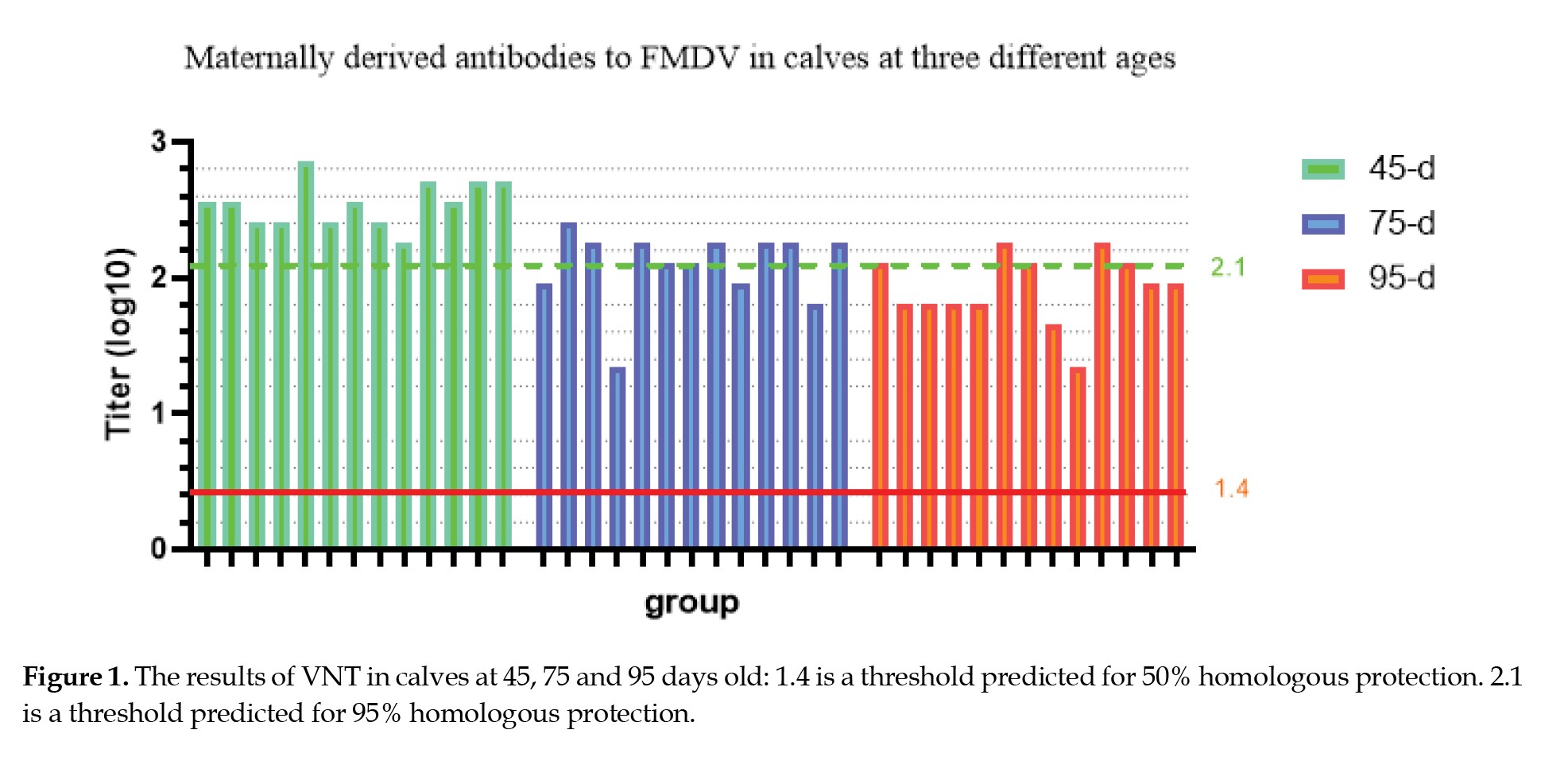
VNT against the A Iran05 (A Irn05) vaccine strain were assessed in calves across three age groups, as illustrated in Figure 1.
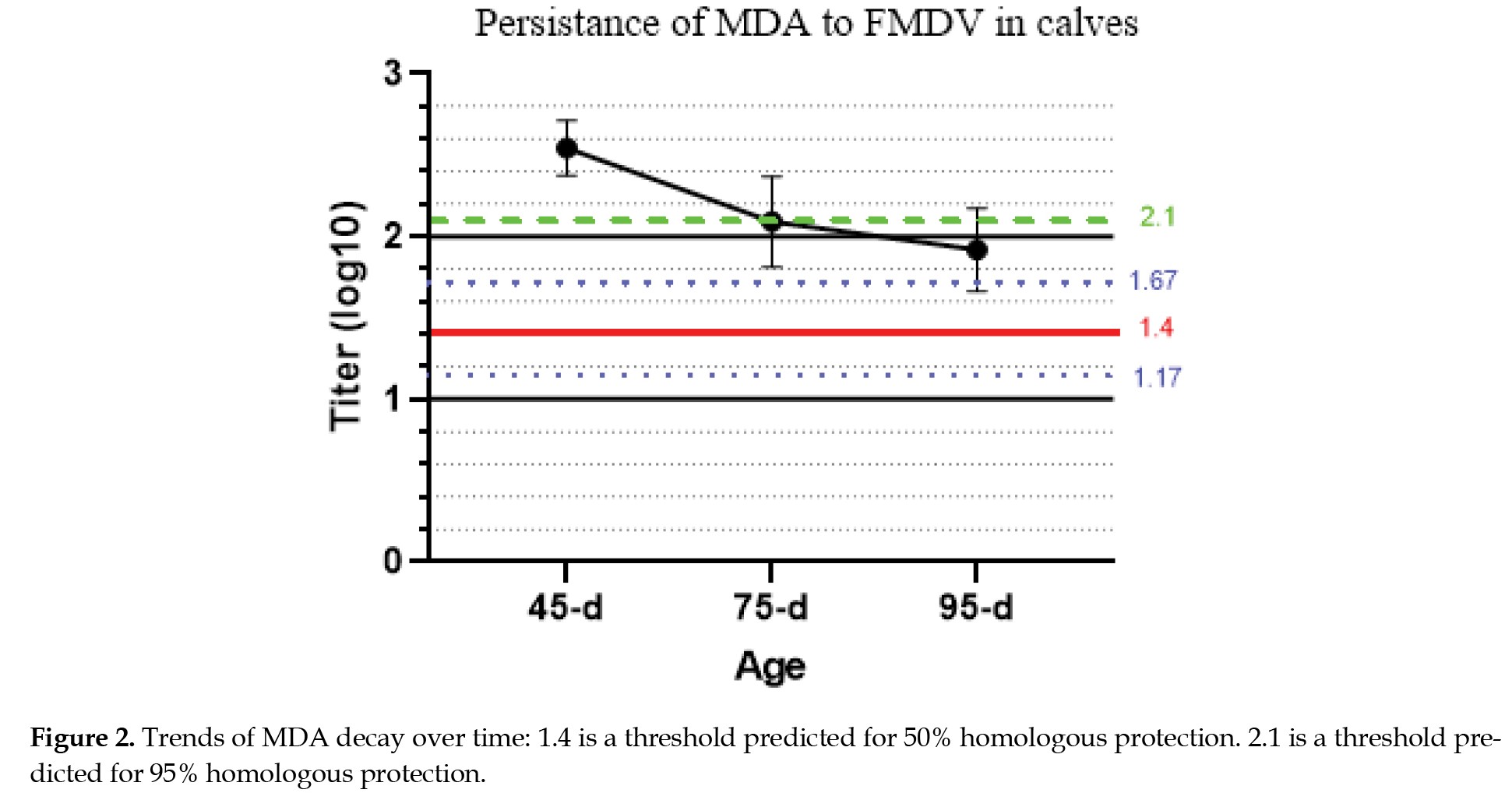
As shown in Figure 2, these titers were inversely correlated with age, indicating a decline in maternally derived antibody levels over time.
At 45, 75, and 95 days of age, VNTs ranged from 2.25 to 2.85 (2.54±0.17), 1.34 to 2.41 (2.09±0.28), and 1.34 to 2.25 (1.92±0.25), respectively (Table 1).
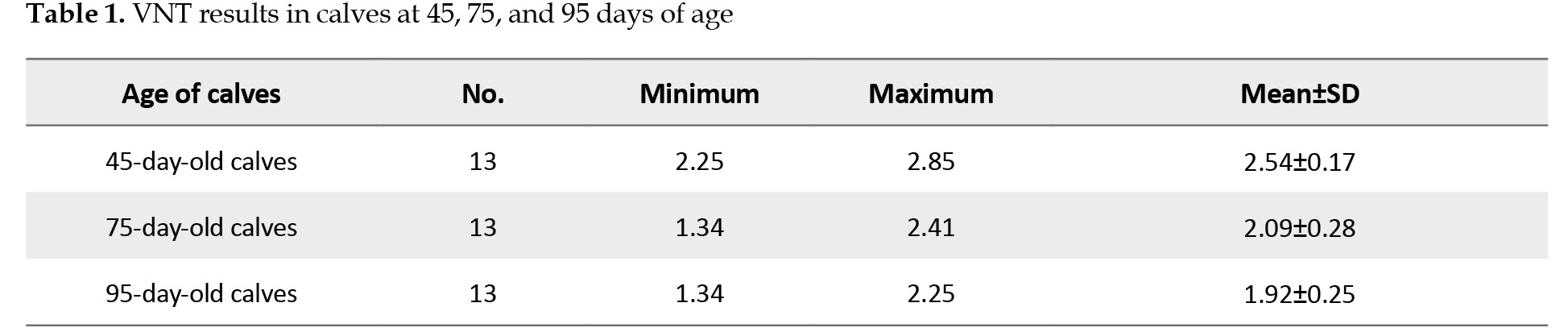
Up to 95 days of age, mean VNTs remained above the threshold predicted for 50% homologous protection (1.4). Notably, at 45 days of age, all calves exhibited VNTs above the threshold predicted for 95% homologous protection (2.1), with a mean VNT of 2.54±0.17. The mean VNT at 75 days of age (2.09±0.28) was nearly equal to the threshold predicted for 95% homologous protection (2.1).
Discussion
Despite the ongoing implementation of Iran’s national FMD control program—including widespread routine vaccination—several outbreaks continue to be reported across the country (Ilbeigi et al., 2018). In Iran, FMD is endemic and occurs throughout the year (Mirzaie et al., 2023). A recent study highlighted Iran’s significant role in contributing to genomic diversity and facilitating the westward spread of South Asian FMDV into Europe (Di Nardo et al., 2021). In endemic regions, like Iran, the primary strategy for controlling FMD centers on comprehensive mass vaccination of all susceptible livestock species (Ilbeigi et al., 2018) and post-vaccination monitoring plays a vital role in evaluating how well FMD vaccines perform under real-world conditions, beyond controlled laboratory settings (Senawi et al., 2023). Based on the mentioned information, extensive research on vaccination in calves—being the most susceptible group—is essential for designing an effective and evidence-based immunization schedule.
It is well established that MDA against FMDV, transferred from immune dams to their offspring via colostrum, provide early protection but can interfere with the development of active immunity. The extent of this interference varies depending on factors, such as the timing of vaccination in both dams and calves, vaccine potency, adjuvant composition, the quantity and timing of colostrum intake, and the types and thresholds of serological tests used to assess protective immunity (Bucafusco et al., 2019; Çokçalışkan et al., 2017; Patil et al., 2014; Senawi et al., 2023). Although several factors influence interference with the development of active immunity, MDA levels are well established as the most significant factor hindering the induction of vaccine-mediated immunity (Bucafusco et al., 2014; Çokçalışkan et al., 2017; Senawi et al., 2023). In our study, high MDA levels were detected through 95 days of age. Based on this information, vaccination against FMDV should not be administered before 95 days of age.
In countries where FMD is endemic, routine vaccination of susceptible livestock is a core strategy for controlling the disease and reducing its economic impact (Elnekave et al., 2016). Vaccination of young calves in the presence of MDA may result in an insufficient humoral response, whereas vaccination of calves with lower MDA titers has been shown to provide protection (Späth et al., 1995; Elnekave et al., 2016). Therefore, determining the trend of MDA decline in calves is important for identifying the optimal time to begin vaccination. Our study showed that calves up to 95 days of age maintain adequate protection against FMD and do not require vaccination during this period. Therefore, vaccination at 75 days of age, as practiced on the farm studied, appears to be too early.
Previous research showed that significant MDA titers persist for 4–5 months (Senawi et al., 2023; Nicholls et al., 1984). Another study showed that vaccinating calves younger than three months resulted in low VNTs against FMDV because of their high MDA levels (Elnekave et al., 2016). A further study showed that MDA in calves born to dams vaccinated in late pregnancy can persist for up to 120 days (Sareyyüpoğlu et al., 2019). The result of our study is almost consistent with these studies. However, we did not sample calves older than 95 days to determine the age at which MDA levels fall below those associated with protection. This was because most farms in our country vaccinate calves between 60 and 90 days of age, and our findings suggest that this may be too early for FMD vaccination.
Conclusion
In farms with good colostrum management and effective vaccination programs, calves up to 95 days of age maintain adequate protection against FMD and likely do not require vaccination during this period. However, the timing of vaccination against FMDV in calves requires further study and investigation. These conclusions apply specifically to the use of aqueous vaccines.
Ethical Considerations
Compliance with ethical guidelines
This study was approved by the Animal Ethics Committee at the Faculty of Veterinary, University of Tehran, Tehran, Iran (Code: IR.UT.VETMED.REC.1402.026).
Funding
This study was extracted from the PhD dissertation of Arman Shokri, approved by the Department of Internal Medicine, Faculty of Veterinary Medicine, University of Tehran, Tehran, Iran.
Authors' contributions
Conceptualization and supervision Samad Lotfollahzadeh and Afshin Raoofi; Writing the original draft and formal analysis: Arman Shokri; Data curation: David Paton and Donald King; Review and editing: Samad Lotfollahzadeh, Afshin Raoofi, David Paton, and Donald King.
Conflict of interest
The authors declared no conflict of interest.
Acknowledgments
The authors wish to thank everyone who contributed their time and experience to this study.
References
Bijari, M., Sadeghi-Sefidmazgi, A., Ansari-Lari, M. & Ghaffari, M. H. (2025). Productivity, reproduction and economic losses due to foot-and-mouth disease (FMD) in Iranian Holstein cows. Preventive Veterinary Medicine, 238, 106471. [DOI:10.1016/j.prevetmed.2025.106471] [PMID]
Bucafusco, D., Di Giacomo, S., Pega, J., Juncos, M. S., Schammas, J. M., & Pérez-Filgueira, M. et al. (2014). Influence of antibodies transferred by colostrum in the immune responses of calves to current foot-and-mouth disease vaccines. Vaccine, 32(48), 6576–6582. [DOI:10.1016/j.vaccine.2014.06.056] [PMID]
Bucafusco, D., Pereyra, R., Mansilla, F. C., Malacari, D. A., Juncos, M. S., & Di Giacomo, S., et al. (2019). Immune cells transferred by colostrum do not influence the immune responses to foot-and-mouth disease primary vaccination. Journal of Dairy Science, 102(9), 8376–8384. [DOI:10.3168/jds.2018-15781] [PMID]
Çokçalışkan, C., Türkoğlu, T., Uzunlu, E., Sareyyüpoğlu, B., Hancı, İ., & İpek, A., et al. (2017). Influence of vaccine potency and booster administration of foot-and-mouth disease vaccines on the antibody response in calves with maternal antibodies. Journal of Veterinary Science, 18(S1), 315–322.[DOI:10.4142/jvs.2017.18.S1.315] [PMID]
Di Nardo, A., Ferretti, L., Wadsworth, J., Mioulet, V., Gelman, B., & Karniely, S., et al. (2021). Evolutionary and ecological drivers shape the emergence and extinction of foot-and-mouth disease virus lineages. Molecular Biology and Evolution, 38(10), 4346–4361. [DOI:10.1093/molbev/msab172] [PMID]
Elnekave, E., Dekker, A., Eble, P., van Hemert-Kluitenberg, F., Gelman, B., & Storm, N. et al. (2016). The long term effect of age and maternally derived antibodies against foot and mouth disease on the serological response following vaccination in young dairy calves. Vaccine, 34(41), 4927–4934. [DOI:10.1016/j.vaccine.2016.07.052] [PMID]
Ilbeigi, K., Bokaie, S., Aghasharif, S., Soares Magalhães, R. J., & Rashtibaf, M. (2018). Risk factors for recurrence of FMD outbreaks in Iran: A case-control study in a highly endemic area. BMC Veterinary Research, 14(1), 253. [DOI:10.1186/s12917-018-1580-3] [PMID]
Jamal, S. M. & Belsham, G. J. (2013). Foot-and-mouth disease: Past, present and future. Veterinary Research, 44(1), 116. [DOI:10.1186/1297-9716-44-116] [PMID]
Khoshnood, S., Azimi, S. M., Ziafati Kafi, Z., Najafi, H., & GhalyanchiLangeroudi, A. (2025). Molecular epidemiology of foot and mouth disease virus in Iran during 2019 and 2023. Scientific Reports, 15(1), 30178. [DOI:10.1038/s41598-025-16115-0] [PMID]
Mirzaie, K., Mowlaei, S., Arsevska, E., Ahmadi, B., Ambrosini, F., & Rosso, F., et al. (2023). Analysis of livestock mobility and implications for the risk of foot-and-mouth disease virus spread in Iran. Ruminants, 3(4), 299-323. [DOI:10.3390/ruminants3040027]
Nicholls, M. J., Black, L., Rweyemamu, M. M., Genovese, J., Ferrari, R., & Hammant, C. A., et al. (1984). The effect of maternally derived antibodies on the response of calves to vaccination against foot and mouth disease. The Journal of Hygiene, 92(1), 105–116. [DOI:10.1017/S0022172400064081] [PMID]
Patil, P. K., Sajjanar, C. M., Natarajan, C. & Bayry, J. (2014). Neutralizing antibody responses to foot-and-mouth disease quadrivalent (type O, A, C and Asia 1) vaccines in growing calves with pre-existing maternal antibodies. Veterinary Microbiology, 169(3-4), 233–235. [DOI:10.1016/j.vetmic.2014.01.005] [PMID]
Sadir, A. M., Schudel, A. A., Laporte, O., Braun, M., & Margni, R. A. (1988). Response to foot-and-mouth disease vaccines in newborn calves. Influence of age, colostral antibodies and adjuvants. Epidemiology and Infection, 100(1), 135–144.[DOI:10.1017/S0950268800065626] [PMID]
Sareyyüpoğlu, B., Gülyaz, V., Çokçalışkan, C., Ünal, Y., Çökülgen, T., & Uzunlu, E., et al. (2019). Effect of FMD vaccination schedule of dams on the level and duration of maternally derived antibodies. Veterinary Immunology and Immunopathology, 217, 109881. [DOI:10.1016/j.vetimm.2019.109881] [PMID]
Senawi, J., Wilsden, G., Browning, C. F., Ludi, A. B., Ismail, M. M., & Senin, H., et al. (2023). Maternally derived antibodies to foot-and-mouth disease virus modulate the antigenic specificity of humoral responses in vaccinated cattle. Vaccines, 11(12), 1844. [DOI:10.3390/vaccines11121844] [PMID]
Singh, R. K., Sharma, G. K., Mahajan, S., Dhama, K., Basagoudanavar, S. H., & Hosamani, M., et al. (2019). Foot-and-mouth disease virus: immunobiology, advances in vaccines and vaccination strategies addressing vaccine failures-an Indian perspective. Vaccines, 7(3), 90. [DOI:10.3390/vaccines7030090] [PMID]
Späth, E. J. A., Smitsaart, E., Casaro, A. P. E., Fondevila, N., Fernández, F., & Leunda, M. R., et al. (1995). Immune response of calves to foot-and-mouth disease virus vaccine emulsified with oil adjuvant. Strategies of vaccination. Vaccine, 13(10), 909–914. [DOI:10.1016/0264-410X(95)00009-P] [PMID]
Sutmoller, P., Barteling, S. S., Olascoaga, R. C. & Sumption, K. J. (2003). Control and eradication of foot-and-mouth disease. Virus Research, 91(1), 101–144. [DOI:10.1016/S0168-1702(02)00262-9] [PMID]
World Organisation for Animal Health (WOAH). (2023). Manual of diagnostic tests and vaccines for terrestrial animals (Terrestrial Manual). Paris: WOAH. [Link]
